Here is a brief biography and history of Sardar
Vallabhai Patel. Read information on life of Indian freedom fighter
Sardar Vallabh Bhai Patel.
Sardar Patel Biography
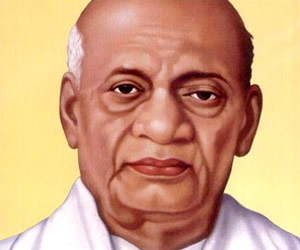
Born: October 31, 1875
Died: December 15, 1950
Achievements: Successfully led Kheda Satyagraha and Bardoli
revolt against British government; elected Ahmedabad's municipal
president in 1922, 1924 and 1927; elected Congress President in 1931;
was independent India's first Deputy Prime Minister and Home Minister;
played a key role in political integration of India; conferred Bharat
Ratna in 1991.
Sardar Patel was popularly known as Iron Man of India. His full name
was Vallabhbhai Patel. He played a leading role in the Indian freedom
struggle and became the first Deputy Prime Minister and Home Minister of
India. He is credited with achieving political integration of India.
Vallabhbhai Patel was born on October 31, 1875 in
Nadiad, a small village in Gujarat. His father Jhaverbhai was a farmer
and mother Laad Bai was a simple lady. Sardar Vallabhai's early
education took place in Karamsad. Then he joined a school in Petlad.
After two years he joined a high school in a town called Nadiad. He
passed his high school examination in 1896. Sardar Vallabhbhai Patel was
a brilliant student throughout his schooling.
Vallabhbhai wanted to become a barrister. To realize this ambition he
had to go to England. But he did not have the financial means to even
join a college India. In those days a candidate could study in private
and sit for an examination in Law. Sardar Vallabh Bhai Patel borrowed
books from a lawyer of his acquaintance and studied at home.
Occasionally he attended courts of law and listened attentively to the
arguments of lawyer. Vallabhbhai passed the Law examination with flying
colours.
Sardar Vallabhbhai Patel started his Law practice in Godhra. Soon his
practice flourished. He got married to Jhaberaba. In 1904, he got a baby
daughter Maniben, and in 1905 his son Dahyabhai was born. Vallabhbhai
sent his elder brother Vitthalbhai, who himself was a lawyer, to England
for higher studies in Law. Patel was only thirty-three years old when
his wife died. He did not wish to marry again. After his brother's
return, Vallabhbhai went to England. He studied with single-minded
devotion and stood first in the Barrister-at-Law Examination.
Sardar Patel returned to India in 1913 and started his practice in
Ahmedabad. Soon he became popular. At the urging of his friends, Patel
contested and won elections to become the sanitation commissioner of
Ahmedabad in 1917. Sardar Patel was deeply impressed by Gandhiji's
success in Champaran Satyagraha. In 1918, there was a drought in the
Kheda division of Gujarat. Peasants asked for relief from the high rate
of taxes but the British government refused. Gandhiji took up peasants
cause but could not devote his full time in Kheda. He was looking for
someone who could lead the struggle in his absence. At this point Sardar
Patel volunteered to come forward and lead the struggle. He gave up his
lucrative legal practice and entered public life.
Vallabhbhai successfully led peasants revolt in Kheda and the revolt
ended in 1919 when the British government agreed to suspend collection
of revenue and roll back the rates. Kheda Satyagraha turned Vallabhbhai
Patel into a national hero. Vallabhbhai supported Gandhi's
Non-Cooperation Movement, and as president of the Gujarat Congress,
helped in organizing bonfires of British goods in Ahmedabad. He gave up
his English clothes and started wearing Khadi. Sardar Vallabh Bhai Patel
was elected Ahmedabad's municipal president in 1922, 1924 and 1927.
During his terms, Ahmedabad was extended a major supply of electricity
and underwent major education reforms. Drainage and sanitation systems
were extended over all the city.
In 1928, Bardoli Taluka in Gujarat suffered from floods and famine. In
this hour of distress the British government raised the revenue taxes by
thirty percent. Sardar Patel took up cudgels on behalf of the farmers
and appealed to the Governor to reduce the taxes. The Governor refused
and the government even announced the date of the collection of the
taxes. Sardar Patel organized the farmers and told them not to pay even
a single pie of tax. The government tried to repress the revolt but
ultimately bowed before Vallabhbhai Patel. It was during the struggle
and after the victory in Bardoli that caused intense excitement across
India, that Patel was increasingly addressed by his colleagues and
followers as Sardar.
Disobedience Movement in 1930. After the signing of Gandhi-Irwin pact in
1931, Sardar Patel was released and he was elected Congress president
for its 1931 session in Karachi. Upon the failure of the Round Table
Conference in London, Gandhiji and Sardar Patel were arrested in January
1932 and imprisoned in the Yeravada Central Jail. During this term of
imprisonment, Sardar Patel and Mahatma Gandhi grew close to one another,
and the two developed a close bond of affection, trust, and frankness
without reserve. Sardar Patel was finally released in July 1934.
In August 1942, the Congress launched the Quit India Movement. The
government jailed all the important leaders of the Congress, including
Vallabhai Patel. All the leaders were released after three years. After
achieving independence on 15th of August 1947, Pandit Jawaharlal Nehru
became the first Prime Minister of independent India and Sardar Patel
became the Deputy Prime Minister. He was in charge of Home Affairs,
Information and Broadcasting and the Ministry of States.
There were 565 princely states in India at that time. Some of the
Maharajas and Nawabs who ruled over these were sensible and patriotic.
But most of them were drunk with wealth and power. They were dreaming of
becoming independent rulers once the British quit India. They argued
that the government of free India should treat them as equals. Some of
them went to the extent of planning to send their representatives to the
United Nations Organization. Patel invoked the patriotism of India's
monarchs, asking them to join in the freedom of their nation and act as
responsible rulers who cared about the future of their people. He
persuaded the princes of 565 states of the impossibility of independence
from the Indian republic, especially in the presence of growing
opposition from their subjects. With great wisdom and political
foresight, he consolidated the small kingdoms. The public was with him.
He tackled the Nizam of Hyderabad and the Nawab of Junagarh who
initially did not want to join India. Sardar Patel's untiring efforts
towards the unity of the country brought success. He united a scattered
nation without much bloodshed. Due to the achievement of this massive
task, Sardar Patel got the title of 'Iron Man'. Sardar Patel died of
cardiac arrest on December 15, 1950. For his services to the nation
Sardar Patel was conferred with Bharat Ratna in 1991.

