Here is a brief biography and history of Maulana
Abul Kalam Azad. Read information on life of Indian freedom fighter
Maulana Azad.
Maulana Abul Kalam Azad Biography
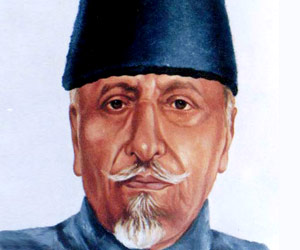
Born: November 11, 1888
Died: February 22, 1958
Achievements: Started a weekly journal Al Hilal to increase the
revolutionary recruits amongst the Muslims; elected as Congress
President in 1923 and 1940; became independent India's first education
minister.
Maulana Abul Kalam Azad's real name was Abul Kalam Ghulam Muhiyuddin.
He was popularly known as Maulana Azad. Maulana Abul Kalam Azad was one
of the foremost leaders of Indian freedom struggle. He was also a
renowned scholar, and poet. Maulana Azad was well versed in many
languages viz. Arabic, English, Urdu, Hindi, Persian and Bengali.
Maulana Azad was a brilliant debater, as indicated by his name, Abul
Kalam, which literally means "lord of dialogue". He adopted
the pen name 'Azad' as a mark of his mental emancipation from a narrow
view of religion and life. Maulana Azad became independent India's first
education minister. For his invaluable contribution to the nation,
Maulana Abul Kalam Azad was posthumously awarded India's highest
civilian honour, Bharat Ratna in 1992.
Maulana Abul Kalam Azad was born on November 11, 1888 in Mecca. His forefather's came from Herat (a city in Afghanistan) in Babar's days. Azad was a descendent of a lineage
of learned Muslim scholars, or maulanas. His mother was an Arab and the
daughter of Sheikh Mohammad Zaher Watri and his father, Maulana
Khairuddin, was a Bengali Muslim of Afghan origins. Khairuddin left
India during the Sepoy Mutiny and proceeded to Mecca and settled there.
He came back to Calcutta with his family in 1890.
Because of his orthodox family background Azad had to pursue
traditional Islamic education. He was taught at home, first by his
father and later by appointed teachers who were eminent in their
respective fields. Azad learned Arabic and Persian first and then
philosophy, geometry, mathematics and algebra. He also learnt English,
world history, and politics through self study.
Azad was trained and educated to become a clergyman. He wrote many
works, reinterpreting the Holy Quran. His erudition led him to repudiate
Taqliq or the tradition of conformity and accept the principle of Tajdid
or innovation. He developed interest in the pan-Islamic doctrines of
Jamaluddin Afghani and the Aligarh thought of Sir Syed Ahmed Khan.
Imbued with the pan-Islamic spirit, he visited Afghanistan, Iraq, Egypt,
Syria and Turkey. In Iraq he met the exiled revolutionaries who were
fighting to establish a constitutional government in Iran. In Egypt he
met Shaikh Muhammad Abduh and Saeed Pasha and other revolutionary
activists of the Arab world. He had a first hand knowledge of the ideals
and spirit of the Young Turks in Constantinople. All these contacts
metamorphosed him into a nationalist revolutionary.
On his return from abroad, Azad met two leading revolutionaries of
Bengal- Aurobindo Ghosh and Sri Shyam Shundar Chakravarty,-and joined
the revolutionary movement against British rule. Azad found that the
revolutionary activities were restricted to Bengal and Bihar. Within two
years, Maulana Abul Kalam Azad, helped setup secret revolutionary
centers all over north India and Bombay. During that time most of his
revolutionaries were anti-Muslim because they felt that the British
Government was using the Muslim community against India's freedom
struggle. Maulana Abul Kalam Azad tried to convince his colleagues to
shed their hostility towards Muslims.
In 1912, Maulana Abul Kalam Azad started a weekly journal in Urdu
called Al Hilal to increase the revolutionary recruits amongst the
Muslims. Al-Hilal played an important role in forging Hindu-Muslim unity
after the bad blood created between the two communities in the aftermath
of Morley-Minto reforms. Al Hilal became a revolutionary mouthpiece
ventilating extremist views. The government regarded Al Hilal as
propogator of secessionist views and banned it in 1914. Maulana Azad
then started another weekly called Al-Balagh with the same mission of
propagating Indian nationalism and revolutionary ideas based on
Hindu-Muslim unity. In 1916, the government banned this paper too and
expelled Maulana Abul Kalam Azad from Calcutta and interned him at
Ranchi from where he was released after the First World War in 1920.
After his release, Azad roused the Muslim community through the Khilafat
Movement. The aim of the movement was to re-instate the Khalifa as the
head of British captured Turkey. Maulana Azad supported Non-Cooperation
Movement started by Gandhiji and entered Indian National Congress in
1920. He was elected as the president of the special session of the
Congress in Delhi (1923). Maulana Azad was again arrested in 1930 for
violation of the salt laws as part of Gandhiji's Salt Satyagraha. He was
put in Meerut jail for a year and a half. Maulana Azad became the
president of Congress in 1940 (Ramgarh) and remained in the post till
1946. He was a staunch opponent of partition and supported a
confederation of autonomous provinces with their own constitutions but
common defence and economy. Partition hurt him greatly and shattered his
dream of an unified nation where Hindus and Muslims can co-exist and
prosper together.
Maulana Abul Kalam Azad served as the Minister of Education in Pandit
Jawaharlal Nehru's cabinet from 1947 to 1958. He died of a stroke on
February 22, 1958.

