Read this biography to learn about the life
history of Indian freedom fighter & political leader Jayaprakash
Narayan.
Jayaprakash Narayan
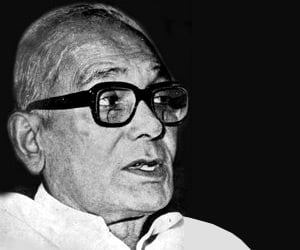
Born - 11 October 1902
Died - 8 October 1979
Achievements - Jayaprakash Narayan was a freedom fighter and
political leader of India. Popularly called JP, Narayan played a pivotal
role in the Quit India movement and earned a lot of fame and respect for
this. During the Quit India Movement too in 1942, JP was at the helm of
the agitation.
Jayaprakash was an Indian freedom fighter and political leader of
India. Popularly called JP by his allies, Narayan is remembered for
spearheading the opposition to Indira Gandhi during the 1970s era. This
biography traces out the political life history of Jayaprakash Narayan
who was born in the Sitabdiara village in the Saran district of Bihar.
Being a bright student, he went on to complete his BA and MA in politics
and sociology from the United States in 1922.
Once in the United States, Jayaprakash Narayan studied the political
science, sociology and economics at the Universities of Berkeley, Iowa,
Wisconsin and Ohio State. He was really impressed by Marxism during his
study at the University of Wisconsin at Madison. The ideas and writings
of M.N. Roy also equally impressed him. But financial problems and his
mother's health caused him to give up his dreams of securing a PhD.
It was while Narayan was returning to India that he got the chance to meet
revolutionaries like Rajani Palme Dutt in London on his way back to
India. As such, he joined the Indian National Congress in 1929 upon
receiving an invitation from Pandit Jawaharlal Nehru. In the time to
come, the great Mahatma Gandhi turned out to be the mentor and guide of
Jayaprakash Narayan. Narayan was jailed and tortured by the British
forces several times during the war for Independence.
Jayaprakash Narayan played a crucial role in the Quit India movement
and earned a lot of fame and respect for this. JP wedded freedom fighter
Prabhavati Devi, who was a follower of Kasturba Gandhi. She resided at
the Sabarmati Ashram while Jayaprakash Narayan was studying abroad.
Though she nurtured viewpoints that contradicted JP's, yet her husband
always respected her independence.
Jayaprakash Narayan met Ram Manohar Lohia, Minoo Masani, Ashok Mehta,
Yusuf Desai and other national leaders when he was put behind bars in
1932 because of the civil disobedience movement. After JP came out of
jail, the Congress Socialist party was set up. While Acharya Narendra
Deva was elected as its President, JP was chosen its general secretary.
During the Quit India Movement in 1942, JP was again at the helm of the
agitation.
Post independence and death of Gandhiji, Jayaprakash Narayan, Acharya
Narendra Dev and Basawon Singh directed the CSP out of Congress to
create the first opposition Socialist Party. This unit later on took the
title Praja Socialist Party. Basawon Singh became the first leader of
the Opposition in the state and assembly of Bihar, whereas Acharya
Narendra Deva became the first leader of opposition in the state and
assembly of U.P.

