Here is a brief biography and history of Dadabhai
Naoroji. Read information on life of Indian Freedom Fighter Dadabhai
Naoroji.
Dadabhai Naoroji Biography
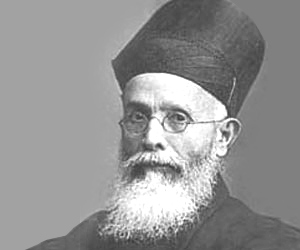
Born: September 4, 1825
Died: June 30, 1917
Achievements: First Indian to become a professor of the college;
instrumental in the establishment of the Indian National Congress; was
President of the Indian National Congress thrice; the Congress' demand
for swaraj (self-rule) was first expressed publicly by him in his
presidential address in 1906
Dadabhai Naoroji is fondly called as the "Grand Old Man of India".
He is viewed as the architect who laid the foundation of the Indian
freedom struggle.
Dadabhai Naoroji was born in a poor Parsi family in Bombay on September
4, 1825. His father, Naoroji Palanji Dordi, died when Dadabhai Naoroji
was only four years old. He was raised by her mother Maneckbai who
despite being illiterate herself ensured that Dadabhai Naoroji got best
English education possible. As a student Dada Bhai Naoroji was very good
in Mathematics and English. He studied at Elphinstone Institution,
Bombay and on completion of his education he was appointed the Head
Native Assistant Master at the Elphinstone Institution. Dadabhai Naoroji
became a professor of Mathematics and Natural Philosophy at Elphinstone
Institution at the age of 27. He was the first Indian to become a
professor of the college.
Dadabhai Naoroji entered the political fray in 1852. He strongly opposed the
renewal of lease to the East India Company in 1853. He sent petitions to
the English government in this regard. But the British government
ignored his pleas and renewed the lease. Dadabhai Naoroji felt that the
British misrule of India was because of ignorance of the Indian people.
He set up the Gyan Prasarak Mandali (Society for Promotion of Knowledge)
for the education of adult menfolk. He wrote several petitions to
Governors and Viceroys regarding India's problems. Ultimately, he felt
that the British people and the British Parliament must be made aware of
India's plight. In 1855, at the age of 30 he sailed for England.
In England, Dadabhai Naoroji joined several learned societies,
delivered many speeches and wrote articles on the plight of India. He
founded the East Indian Association on December 1st, 1866. The
association was comprised of high-ranking officers from India and people
who had access to Members of the British Parliament. Dadabhai Naoroji
was elected to the British Parliament in 1892 from Central Finsbury as
the Liberal party candidate. He got a resolution passed in British
Parliament for holding preliminary examinations for the I.C.S. in India
and England simultaneously. He also got the Wiley Commission, the royal
commission on India expenditure, to acknowledge the need for even
distribution of administrative and military expenditure between India
and England.
Dadabhai Naoroji was instrumental in the establishment of the Indian
National Congress founded by A.O. Hume in 1885. Thrice he was elected to
the post of the President of the Indian National Congress, in 1886, 1893
and in 1906. During his third term, he prevented a split between
moderates and extremists in the party. The Congress' demand for swaraj
(self-rule) was first expressed publicly by him in his presidential
address in 1906. Dadabhai Naoroji believed in non-violent and
constitutional methods of protest. He died at the age of 92 on June 30,
1917.

