Here is a brief biography of Aurobindo Ghose. Read
information on life of Indian freedom fighter & philosopher Sri
Aurobindo Ghosh.
Aurobindo Ghose Biography
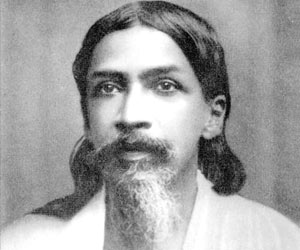
Born: August 15, 1872
Died: December 5, 1950
Achievements: He was a freedom fighter, poet, scholar, yogi and
philosopher. Worked towards the cause of India’s freedom, and for
further evolution of life on earth.
Aurobindo Ghose was a multifaceted person. He was a freedom fighter,
poet, scholar, yogi and philosopher. He spent his life working towards
the cause of India’s freedom, and for further evolution of life on
earth.
Sri Aurobindo Ghosh was born on August 15, 1872 at Calcutta. His father
was Krishnadhan and his mother was Swamalata. Aurobindo Ghose had an
impressive lineage. Raj Narayan Bose, an acknowledged leader in Bengali
literature, and the grandfather of Indian nationalism was Sri Aurobindo’s
maternal grandfather. Aurobindo Ghosh owes not only his rich spiritual
nature, but even his very superior literary capacity, to his mother’s
line. His father was an M.D. from England.
When Sri Aurobindo was five years old,
he was sent to Loretto Convent School at Darjeeling. Two years later in
1879, Aurobindo Ghose, was sent to England along with his brothers for
higher studies. Aurobindo completed his schooling from St. Paul's in
London. In 1890, at the age of eighteen, Sri Aurobindo got admission
into Cambridge. Here, he distinguished himself as a student of European
classics. To comply with the wish of his father, Sri Aurobindo Ghose
also applied for the ICS while at Cambridge. He passed the Indian Civil
Service Examination with great credit in 1890. He, however, failed to
stand the required test in horsemanship and hence was not allowed to
enter the Covenantal Service of the Indian Government.
In 1893, Aurobindo Ghose, returned to India, and became the
Vice-principal of the State college in Baroda. He drew a salary of
Rs.750/-. He was held in great respect by the Maharaja of Baroda.
Aurobindo was an accomplished scholar in Greek and Latin. From 1893 to
1906 he extensively studied Sanskrit, Bengali literature, Philosophy and
Political Science.
In 1906, in the wake of partition of Bengal, resigned his job and
joined the Bengal National College on a salary of Rs.150/-. He plunged
headlong into the revolutionary movement. Aurobindo Ghose played a
leading role in India’s freedom struggle from 1908. Sri Aurobindo
Ghosh was one of the pioneers of political awakening in India. He edited
the English daily Bande Mataram and wrote fearless and pointed
editorials. He openly advocated the boycott of British goods, British
courts and everything British. He asked the people to prepare themselves
for passive resistance.
The famous Alipore Bomb Case proved to be a turning point in Sri
Aurobindo Ghosh’s life. For a year Aurobindo was an undertrial
prisoner in solitary confinement in the Alipore Central Jail. It was in
a dingy cell of the Alipore Jail that he dreamt the dream of his future
life, the divine mission ordained for him by God. He utilized this
period of incarceration for an intense study and practice of the
teachings of the Bhagavad Gita. Chittaranjan Das defended Sri Aurobindo,
who was acquitted after a memorable trial.
During his time in prison, Aurobindo Ghosh, had developed interest in
yoga and meditation. After his release he started practicing pranayama
and meditation. Sri Aurobindo Ghose migrated from Calcutta to
Pondicherry in 1910. At Pondicherry, he stayed at a friend’s place.
At first, he lived there with four or five companions. Gradually the
number of members increased and an Ashram was founded.
In 1914 after four years of
concentrated yoga at Pondicherry, Sri Aurobindo launched Arya, a 64 page
monthly review. For the next six and a half years this became the
vehicle for most of his most important writings, which appeared in
serialised form. These included Essays on The Gita, The Secret of The
Veda, Hymns to the Mystic Fire, The Upanishads, The Foundations of
Indian Culture, War and Self-determination, The Human Cycle, The Ideal
of Human Unity, and The Future Poetry. In 1926, Sri Aurobindo Ghose
retired from public life.
Sri Aurobindo’s philosophy is based on facts, experience and
personal realisations and on having the vision of a seer or Rishi.
Aurobindo’s spirituality was inseparably united with reason. The
goal of Sri Aurobindo was not merely the liberation of the individual
from the chain that fetters him and realization of the self, but to work
out the will of the Divine in the world, to effect a spiritual
transformation and to bring down the divine nature and a divine life
into the mental, vital and physical nature and life of humanity.
Sri Aurobindo passed away on December 5, 1950 at Pondicherry at the age
of 78.

