Here is a brief biography and history of
Chandrashekhar Azad. Read information on life of Indian Freedom Fighter
Chandrashekhar Azad.
Chandrashekhar Azad Biography
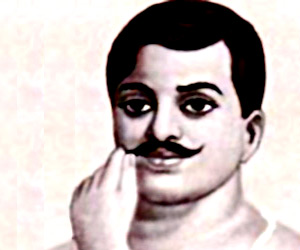
Born: July 23,1906
Martyrdom: February 27, 1931
Achievements: Involved in Kakori Train Robbery (1926), the
attempt to blow up the Viceroy's train (1926), and the shooting of
Saunders at Lahore (1928) to avenge the killing of Lala Lajpatrai;
formed Hindustan Socialist Republican Association with fellow
compatriots Bhagat Singh, Sukhdev, and Rajguru.
Chandrashekhar Azad was a great Indian freedom fighter. His fierce
patriotism and courage inspired others of his generation to enter
freedom struggle. Chandrasekhar Azad was the mentor Bhagat Singh,
another great freedom fighter, and along with Bhagat Singh he is
considered as one of the greatest revolutionaries that India has
produced.
Chandra Shekhar Azad was born on July 23,1906 in Badarka village of Unnao district in Uttar Pradesh. His parents were Pandit Sitaram Tiwari and Jagarani Devi.Pandit Sitaram Tiwari was serving in erstwhile estate of Alirajpur (situated in present day Madhya Pradesh) and Chandra Shekhar Azad's childhood was spent in the village Bhabra . On the insistence of her mother Jagrani Devi, Chandra Shekhar Azad went to Kashi Vidyapeeth, Benaras for studying Sanskrit.
Chandrashekhar Azad was deeply troubled by the Jallianwala Bagh
Massacre in Amritsar in 1919. In 1921, when Mahatma Gandhi launched
Non-Cooperation movement, Chandrasekhar Azad actively participated in
revolutionary activities. He received his first punishment at the age of
fifteen. Chandra Shekhar was caught while indulging in revolutionary
activities. When the magistrate asked him his name, he said "Azad"
(meaning free). Chandrashekhar Azad was sentenced to fifteen lashes.
With each stroke of the whip the young Chandrasekhar shouted "Bart
Mata Kid Jai". From then on Chandrashekhar assumed the title of
Azad and came to known as Chandrashekhar Azad. Chandrashekhar Azad vowed
that he would never be arrested by the British police and would die as
free man.
After the suspension of non-cooperation movement Chandrashekhar Azad
was attracted towards more aggressive and revolutionary ideals. He
committed himself to complete independence by any means. Chandrashekhar
Azad and his compatriots would target British officials known for their
oppressive actions against ordinary people and freedom fighters.
Chandrashekhar Azad was involved in Kakori Train Robbery (1926), the
attempt to blow up the Viceroy's train (1926), and the shooting of
Saunders at Lahore (1928) to avenge the killing of Lala Lajpatrai.
Along with Bhagat Singh and other compatriots like Sukhdev and Rajguru,
Chandrashekhar Azad formed the Hindustan Socialist Republican
Association (HRSA). HRSA was committed to complete Indian independence
and socialist principles for India's future progress.
Chandrashekhar Azad was a terror for British police. He was on their
hit list and the British police badly wanted to capture him dead or
alive. On February 27, 1931 Chandrashekhar Azad met two of his comrades
at the Alfred Park Allah bad. He was betrayed by an informer who had
informed the British police. The police surrounded the park and ordered
Chandrashekhar Azad to surrender. Chandrashekhar Azad fought alone
valiantly and killed three policemen. But finding himself surrounded and
seeing no route for escape, Chandrashekhar Azad shot himself. Thus he
kept his pledge of not being caught alive.

