Here is a brief biography and history of Dr. B.R.
Ambedkar. Read information on life of Baba Saheb Bhimrao Ambedkar.
Dr. B.R. Ambedkar Biography
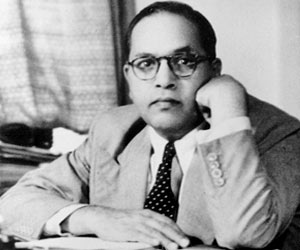
Born: April 14, 1891
Died: December 6, 1956
Achievements: Dr. B.R. Ambedkar was elected as the chairman of
the drafting committee that was constituted by the Constituent Assembly
to draft a constitution for the independent India; he was the first Law
Minister of India; conferred Bharat Ratna in 1990.
Dr. B.R. Ambedkar is viewed as messiah of dalits and downtrodden in
India. He was the chairman of the drafting committee that was
constituted by the Constituent Assembly in 1947 to draft a constitution
for the independent India. He played a seminal role in the framing of
the constitution. Bhimrao Ambedkar was also the first Law Minister of
India. For his yeoman service to the nation, B.R. Ambedkar was bestowed
with Bharat Ratna in 1990.
Dr.Bhimrao Ambedkar was born
on April 14, 1891 in Mhow (presently in Madhya Pradesh). He was the
fourteenth child of Ramji and Bhimabai Sakpal Ambavedkar. B.R. Ambedkar
belonged to the "untouchable" Mahar Caste. His father and
grandfather served in the British Army. In those days, the government
ensured that all the army personnel and their children were educated and
ran special schools for this purpose. This ensured good education for
Bhimrao Ambedkar, which would have otherwise been denied to him by the
virtue of his caste.
Bhimrao Ambedkar experienced caste discrimination right from the
childhood. After his retirement, Bhimrao's father settled in Satara
Maharashtra. Bhimrao was enrolled in the local school. Here, he had to
sit on the floor in one corner in the classroom and teachers would not
touch his notebooks. In spite of these hardships, Bhimrao continued his
studies and passed his Matriculation examination from Bombay University
with flying colours in 1908. Bhim Rao Ambedkar joined the Elphinstone
College for further education. In 1912, he graduated in Political
Science and Economics from Bombay University and got a job in Baroda.
In 1913, Bhimrao Ambedkar lost his father. In the same year Maharaja of
Baroda awarded scholarship to Bhim Rao Ambedkar and sent him to America
for further studies. Bhimrao reached New York in July 1913. For the
first time in his life, Bhim Rao was not demeaned for being a Mahar. He
immersed himself in the studies and attained a degree in Master of Arts
and a Doctorate in Philosophy from Columbia University in 1916 for his
thesis "National Dividend for India: A Historical and Analytical
Study." From America, Dr.Ambedkar proceeded to London to study
economics and political science. But the Baroda government terminated
his scholarship and recalled him back.
The Maharaja of Baroda appointed Dr. Ambedkar as his political
secretary. But no one would take orders from him because he was a Mahar.
Bhimrao Ambedkar returned to Bombay in November 1917. With the help of
Shahu Maharaj of Kolhapur, a sympathizer of the cause for the upliftment
of the depressed classes, he started a fortnightly newspaper, the "Mooknayak"
(Dumb Hero) on January 31, 1920. The Maharaja also convened many
meetings and conferences of the "untouchables" which Bhimrao
addressed. In September 1920, after accumulating sufficient funds,
Ambedkar went back to London to complete his studies. He became a
barrister and got a Doctorate in science.
After completing his studies in London, Ambedkar returned to India. In
July 1924, he founded the Bahishkrit Hitkaraini Sabha (Outcastes Welfare
Association). The aim of the Sabha was to uplift the downtrodden
socially and politically and bring them to the level of the others in
the Indian society. In 1927, he led the Mahad March at the Chowdar Tank
at Colaba, near Bombay, to give the untouchables the right to draw water
from the public tank where he burnt copies of the 'Manusmriti' publicly.
In 1929, Ambedkar made the
controversial decision to co-operate with the all-British Simon
Commission which was to look into setting up a responsible Indian
Government in India. The Congress decided to boycott the Commission and
drafted its own version of a constitution for free India. The Congress
version had no provisions for the depressed classes. Ambedkar became
more skeptical of the Congress's commitment to safeguard the rights of
the depressed classes.
When a separate electorate was announced for the depressed classes
under Ramsay McDonald 'Communal Award', Gandhiji went on a fast unto
death against this decision. Leaders rushed to Dr. Ambedkar to drop his
demand. On September 24, 1932, Dr. Ambedkar and Gandhiji reached an
understanding, which became the famous Poona Pact. According to the pact
the separate electorate demand was replaced with special concessions
like reserved seats in the regional legislative assemblies and Central
Council of States.
Dr. Ambedkar attended all the three Round Table Conferences in London
and forcefully argued for the welfare of the "untouchables".
Meanwhile, British Government decided to hold provincial elections in
1937. Dr. B.R. Ambedkar set up the "Independent Labor Party"
in August 1936 to contest the elections in the Bombay province. He and
many candidates of his party were elected to the Bombay Legislative
Assembly.
In 1937, Dr. Ambedkar introduced a Bill to abolish the "khoti"
system of land tenure in the Konkan region, the serfdom of agricultural
tenants and the Mahar "watan" system of working for the
Government as slaves. A clause of an agrarian bill referred to the
depressed classes as "Harijans," or people of God. Bhimrao was
strongly opposed to this title for the untouchables. He argued that if
the "untouchables" were people of God then all others would be
people of monsters. He was against any such reference. But the Indian
National Congress succeeded in introducing the term Harijan. Ambedkar
felt bitter that they could not have any say in what they were called.
In 1947, when India became independent, the first Prime Minister Pt.
Jawaharlal Nehru, invited Dr. Bhimrao Ambedkar, who had been elected as
a Member of the Constituent Assembly from Bengal, to join his Cabinet as
a Law Minister. The Constituent Assembly entrusted the job of drafting
the Constitution to a committee and Dr. Ambedkar was elected as Chairman
of this Drafting Committee. In February 1948, Dr. Ambedkar presented the
Draft Constitution before the people of India; it was adopted on
November 26, 1949.
In October 1948, Dr. Ambedkar submitted the Hindu Code Bill to the
Constituent Assembly in an attempt to codify the Hindu law. The Bill
caused great divisions even in the Congress party. Consideration for the
bill was postponed to September 1951. When the Bill was taken up it was
truncated. A dejected Ambedkar relinquished his position as Law
Minister.
On May 24, 1956, on the occasion of Buddha Jayanti, he declared in
Bombay, that he would adopt Buddhism in October. On 0ctober 14, 1956 he
embraced Buddhism along with many of his followers. On December 6, 1956,
Baba Saheb Dr. B.R. Ambedkar died peacefully in his sleep.

