
It was in 1931 that a British mountaineer, Franksmith, found this valley while returning from an expedition to Mt. Kamat. Enchanted by the picturesque beauty of the valley, he named it as 'Valley of Flowers'. The main valley starts after crossing the gorge and the stream that starts from Nar Parvat. Ratban Parvat provides a beautiful facade to the Valley of Flowers National Park, while the Kunt Khal forms its backdrop. To the left is Nar Parvat, which separates Badrinath Valley from the Valley of Flowers.
Flora
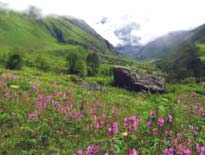 Valley of Flowers National Park is fed mainly by Pushpavati River.
There are also a number of waterfalls that add to the pristine beauty of
the park. Starting from mid-July, the snow melts down and the flowers
come out in their full bloom, which continues for around three months.
Over 300 species of wild flowers can be seen at the Valley of Flowers
National Park. These include Marsh Marigold, Lilium, Campanula,
Pedicularis, Arisaema, Geranium, Bistorta, Ligularia, Epilobium,
Rhododendrons, Corydalis, Inula, Braham Kamal, Cypripedium, etc.
Valley of Flowers National Park is fed mainly by Pushpavati River.
There are also a number of waterfalls that add to the pristine beauty of
the park. Starting from mid-July, the snow melts down and the flowers
come out in their full bloom, which continues for around three months.
Over 300 species of wild flowers can be seen at the Valley of Flowers
National Park. These include Marsh Marigold, Lilium, Campanula,
Pedicularis, Arisaema, Geranium, Bistorta, Ligularia, Epilobium,
Rhododendrons, Corydalis, Inula, Braham Kamal, Cypripedium, etc. Wildlife
The wildlife found at the Valley of Flowers National Park of India comprises of Snow Leopard, Himalayan Bear, Himalayan Mouse Hare, Musk Deer, Blue Sheep, etc. A number of butterfly species also inhabit this park.
How to Reach Valley of Flowers National Park
By Air: Jolly Grant airport of Dehradun falls the nearest to the Valley of Flowers.
By Rail: The railway station nearest to Valley of Flowers is situated at Rishikesh.
By Road: Valley of Flowers is well connected with most of the major cities of India.

