
Debate
There is some disagreement regarding the genus to which the snow leopard belongs. Some taxonomists believe that it belongs to the genus Panthera, while others believe that it has own genus, Uncia.
No Connection with Leopard
Despite the common misconception, the snow leopard has no relation with the leopard. Infact, some people believe that it has a close connection with cheetah. Both of them show similar physical traits to quite an extent and both are incapable of roaring.
Physical traits
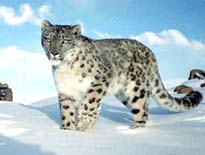 The coat of a snow leopard of India is gray in color and is covered
with ringed spots and rosettes of black or brown. The tail is striped
and the fur is soft as well as beautiful. The tail as well as the bottom
part of the paws of snow leopards is covered with fur. Snow leopards may
weigh upto 75 kg and the length of their head and body may reach 59
inches. Their tail is also quite long and measures between 31 and 39
inches. The head of a male snow leopard is much squarer and wider than
that of the female.
The coat of a snow leopard of India is gray in color and is covered
with ringed spots and rosettes of black or brown. The tail is striped
and the fur is soft as well as beautiful. The tail as well as the bottom
part of the paws of snow leopards is covered with fur. Snow leopards may
weigh upto 75 kg and the length of their head and body may reach 59
inches. Their tail is also quite long and measures between 31 and 39
inches. The head of a male snow leopard is much squarer and wider than
that of the female.Natural Habitat
During summer season, snow leopards prefer to stay either above the tree line on mountainous meadows or in the rocky regions of the Indian subcontinent, which are upto 6000 m in height. Winter season is the time for them to come down to an altitude of somewhere around 2000 m. The home range of a snow leopard varies to quite an extent. For example, in Nepal, they need only 30-65 sq km to survive, while, in Mongolia, their range increase to 1,000 sq km. In central and south Asia, they are found in Afghanistan, Bhutan, China, India, Kazakhstan, the Kyrgyz Republic, Mongolia, Nepal, Pakistan, Russia, Tajikistan, and Uzbekistan.
Behavior
We mostly find snow leopards leading isolated lives and rarely forming any groups. Usually, they kill animals, which are thrice as big as they are.
Mating behavior
The mating season of the snow leopard extends from January to May and the gestation period is usually of 98 to 103 days.
Diet
Snow leopards are carnivores and have a diet consisting of ibex, bharal, markhor, urial, boars, marmots and other small rodents.
Status
Snow leopards have been listed under CITES, Appendix I, Endangered Species Act. Their total population (throughout the world) ranges between 3,500 and 7,000 in the wild and 600 to 700 being in the various zoos of the world.
National Parks
Snow leopards are mainly found in the following national parks of India:

