
The rulers of the Gupta Empire were efficient administrators who knew how to govern with a firm hand without being despotic. During this age, art and education flourished and many great discoveries were made in these fields. Aryabhatta and Varahamihira, the two great mathematicians contributed much during this period in the field of Vedic Mathematics. Aryabhatta estimated the value of "Pi" to the fourth decimal place. Algebra was developed to a great extent and the concepts of zero and infinity were found. The symbols of numbers 1 to 9 were devised which was a great contribution in mathematics. These symbols came to be known as Hindu Arabic numerals later when the Arabs too adopted them.
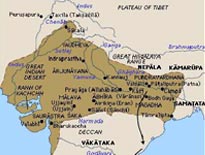 The Gupta Age is also known for its advances in astronomy. During the
reign of the Gupta rulers, astronomers and philosophers proposed the
theory that the earth was not flat but round. The theory of gravity was
also propounded during this time. The astronomers made a breakthrough
when they found out the different planets and started to make horoscopes
based on the planetary positions. The field of medicine also advanced a
lot during this time and doctors used to perform operations even during
that era. Since so many discoveries and advances were made in arts, medicine, literature and science during Gupta
period, it has been called the Golden Age of India.
The Gupta Age is also known for its advances in astronomy. During the
reign of the Gupta rulers, astronomers and philosophers proposed the
theory that the earth was not flat but round. The theory of gravity was
also propounded during this time. The astronomers made a breakthrough
when they found out the different planets and started to make horoscopes
based on the planetary positions. The field of medicine also advanced a
lot during this time and doctors used to perform operations even during
that era. Since so many discoveries and advances were made in arts, medicine, literature and science during Gupta
period, it has been called the Golden Age of India. Main Rulers of Gupta Age

