
Jahangir received the best education that was available at that time. His father Akbar was very particular that his son received the best education that was available in the kingdom. At the age of four he was taught Turkish, Urdu, Persian, Arabic, Arithmetic, Geography, History, Sciences, etc. At a very young age, he was given the rank of a Mansabdar of ten thousand, which is the highest rank in military after the Emperor. At the mere age of twelve, he commanded a regiment independently in the Kabul campaign.
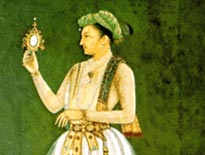 Emperor Jahangir married many times and the girls were from very
high-class noble families of the Mughals and Rajputs. A Rajput princess
known as Jagat Gosain was his favorite and she gave birth to Shah Jahan,
Jahangir's successor. He also married the famous Noor Jahan, who was the
widow of Sher Afghan. Noor Jahan was supposed to be unparalleled in
beauty and intelligence. This was the reason why Jahangir was attracted
towards her. She proved to be the driving force behind Jahangir and made
him strengthen the empire.
Emperor Jahangir married many times and the girls were from very
high-class noble families of the Mughals and Rajputs. A Rajput princess
known as Jagat Gosain was his favorite and she gave birth to Shah Jahan,
Jahangir's successor. He also married the famous Noor Jahan, who was the
widow of Sher Afghan. Noor Jahan was supposed to be unparalleled in
beauty and intelligence. This was the reason why Jahangir was attracted
towards her. She proved to be the driving force behind Jahangir and made
him strengthen the empire. Jahangir loved fine arts and encouraged the growth the poetry, paintings, dance, music, etc. He was also a good writer and loved nature. He penned down his life and his experiences in the form of an autobiography named Tuzk-e-Jahangiri. He was a collector of paintings and many of them are still preserved in a museum. He was famous for his "Chain of Justice", which was a golden chain attached to some bells outside his palace. Anyone in despair could pull the chain and go in for a personal hearing from the emperor himself. Jahangir died in the year 1627 and was buried in a magnificent tomb at a place called Shahdra, located in present day Pakistan.

