
Behavior
Indian sambar deer typically display solitary and isolated behavior. Most of the time, they are seen roaming alone. In case they have company, it is that of a very small group. The senses of sambar deer are highly developed, which helps them in detecting their predators easily. Whenever they perceive danger, they start giving a repetitive honking alarm call.
Natural Habitat
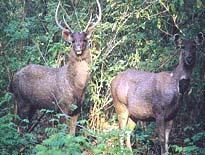 Sambar deer are found inhabiting mainly damp woodland environments of
the Indian subcontinent, like marshes and swamps. One can hardly find
them residing far from water, but they can be found at high elevations
also. The other natural habitat of the Sambar deer comprises of Indian
temperate forests. Apart from India, Sambhur deer is found in the slopes
of the Himalayan Mountains, Burma, Thailand, Indochina, the Malay
Peninsula, southern China, Taiwan and the islands of Sumatra and Borneo
in Indonesia.
Sambar deer are found inhabiting mainly damp woodland environments of
the Indian subcontinent, like marshes and swamps. One can hardly find
them residing far from water, but they can be found at high elevations
also. The other natural habitat of the Sambar deer comprises of Indian
temperate forests. Apart from India, Sambhur deer is found in the slopes
of the Himalayan Mountains, Burma, Thailand, Indochina, the Malay
Peninsula, southern China, Taiwan and the islands of Sumatra and Borneo
in Indonesia.Diet
Sambur deer of India are herbivores and survive on a diet consisting of coarse vegetation, grass, and herbs. Their staple diet includes grass, sprigs, fruits and bamboo buds.
Mating Behavior
The mating period of the Indian sambhur deer falls in the month of November/December. The male deer guard their rutting territories and try to attract the female deer through vocal and olfactory displays. The gestation period of sambar deer is approximately 6 months and, usually, they give birth to a single offspring only.
National Parks
Sambar deer is easily spotted in the following national parks of India:

